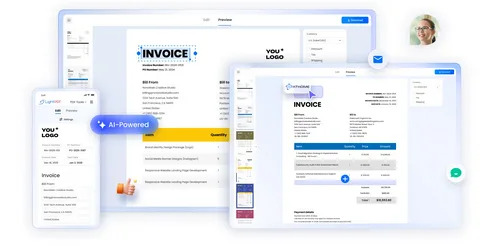
Suppliers, vendors and service providers handle thousands of invoices daily for businesses. As the number of transactions grows, financial teams need to keep records of approvals, paperwork, and payments more accurate than ever. So, digital solutions are assessed to ensure consistency throughout the financial workflows while also meeting the organization's need.
Systems for organizing invoice data and streamlining complex financial operations are essential in modern financial operations. AI invoice management software integrates intelligent data recognition and automation to streamline invoice management in a departmental manner. It does not replace financial oversight but establishes a more clear-cut workflow, making invoice handling more functional, secure and future-proof according to the needs of the business.
Each company has its own procedure for issuing and paying invoices. While some companies handle hundreds of invoices per month, others handle thousands of invoices across various departments. Operational challenges such as delayed approvals, duplicate records and lost documents are frequently encountered when dealing with manual data entry, which can slow down financial activity.
To choose any software, the first step is to identify the existing issues of the workflow in organisations. Recognising such matters can make it possible for choice-makers to evaluate offered options and also solutions to the existing company needs instead of picking the technology due to functions. AI invoice management software should align with the organisation's goals and not impose unnecessary changes on the financial operations of teams.
Software choices need to start with definite business goals. Finance teams might want quicker approvals, unified document administration or improved reporting and analysis. Depending on the size of the company, multi-location coordination might be needed for large companies, and workflow consistency and document accuracy for smaller organizations.
The future growth of the organization should also be taken into account. As businesses grow in size, it is common to have more invoices and a more complex way of doing business. Choosing the right software that is compatible with future goals fosters a better foundation for financial management in the future.
Today, the use of smart technologies in invoices is based on the ability to extract information from electronic documents. The numbers and vendors on an invoice, the payment amount, and the date of the transactions are read using optical character recognition and artificial intelligence and do not require much manual work.
Correct data extraction minimises document-to-document and accounting record inconsistencies. Before choosing a platform, finance teams should look at the accuracy of the recognition before they use it in various formats of invoices. Businesses should always rely on AI invoice management software that accurately recognizes financial data yet preserves document integrity in different business contexts.
Applying for invoices is normally a multi-department and multi-management-level process. The traditional approval process is time-consuming because documents are physically passed from employee to employee or office. Automated workflows set up a series of approvals according to organizational policies and financial thresholds.
The ability to set up approval processes also ensures accountability during the review process. The system records the approval stage and provides an invoice to the manager based on his/her responsibility. These workflows are structured in a way that provides more visibility in financial operations.
Invariably, companies keep invoices for accounting purposes, audits and compliance. Manual record keeping and searching through disjointed digital files are time-consuming and add to administration.
The best document management keepers keep documents organised in a searchable database. Records are found by the user by name of the supplier, invoice number, date and/or payment status. The centralized storage also ensures that all the documents are well documented and easy to access for historical records when it comes to financial reviews and compliance.
There are several financial instruments that are used by modern businesses for accounting, financial reporting and payroll management. It is crucial for any kind of invoice system to merge seamlessly with these present systems. Data duplication and workflow inconsistencies are caused by poor integration, leading to inefficiency in operations.
An integrated system allows invoices to be linked seamlessly to accounting systems, minimizing data entry. This helps to maintain uniformity in financial data and enhances the reliability of the data throughout the organization.
Scalability is one of the factors to consider when choosing software. Standard businesses expand with time, and the quantity of invoices can grow as the business expands. A good system for a small operation might not work so well on a large operation.
Platforms need to be assessed as to their ability to scale as the volume of invoice data increases without compromising performance. AI invoice management software should operate smoothly even at high transaction volumes, across multiple departments or locations.
Cloud-based systems offer access to invoice information from various places. This is especially beneficial for companies that have remote workers or operations spread throughout. Cloud accessibility guarantees financial information is readily available in real-time.
Consistency of performance is also important. Slow systems impact decision times and diminish productivity. Before committing to a decision, companies need to consider response time, uptime of systems and reliability.
Employees have low rates of adoption due to a complicated interface. Finance teams like systems that are easy to use and don't need extensive training and have navigation structures that are easy to understand. Simple dashboards enable users to easily monitor reports, approvals and invoices.
Usability relates directly to productivity. If the employees find it hard to use, they might still be using manual methods with it. This hampers the effectiveness of the automation tools as a whole.
Security and Compliance Considerations
Financial data needs to be properly secured. Typical information found in an invoice is sensitive business and vendor information. Encryption, secure storage and access controls are essential elements of any security protocols. Before implementing a platform, companies must assess the method of data storage and security measures. Security is a core piece of the puzzle in achieving trust and in meeting regulatory requirements.
Not all employees need to have access to financial information. Roles have appropriate access and only see or manage information related to their roles. This minimizes the threat of unauthorized changes or the use of the data. Controlled access also makes it easier with regard to accountability. All actions in the system are recorded and associated with users, thus providing transparency in the financial operations of the system.
Compliance with financial regulations and audit requirements must be adhered to by businesses. Invoice systems should have a good structure which makes it easier to report to comply with regulations and external audits. A compliant system will ensure that financial information can be traced and well documented. This helps to minimize legal risks and enhance financial governance in the future.
Each and every action made in the system is tracked in the audit trails. These logs cover the creation or changes to invoices, invoice approval and payment. They give a full record of finance activity. Activity tracking increases transparency and makes it quicker to detect irregularities. It also provides facilitation for internal audits and enhances financial accountability.
Modern systems of invoices have included reporting capabilities that will bring about insights about monetary performance. These reports contain payment cycles, pending approvals and vendor activity trends.
Analytics can help businesses to make informed financial decisions based on actual data. This helps in the accuracy of budgeting and operational planning over time.
Vendor reliability should be evaluated when selecting software. Periodic updates keep systems current to meet evolving business needs and technologies.
Stable vendors offer long-term support and help enhance system performance by applying updates. This means that there will be no constant interruptions.
Each organization has a distinct financial procedure. Businesses can tailor systems for approvals, data fields, and reporting to meet their requirements.
Compatibility is also important in the future. Systems need to be flexible to new tools and standards for integration as technology changes without having to be fully replaced.
Costs should cover licensing fees, implementation costs, training and ongoing maintenance. These costs should be weighed against potential efficiency gains and improvements in operations.
A transparent cost structure can guide organizations to make informed decisions without any last-minute surprises.
The selection of software should be based on the current financial processes, not on changing them. The smoother and more effective the adoption of systems when they match operational needs.
When properly assessed, it minimizes the chances of data inaccuracies, delays in workflow, and system compatibility issues. By choosing tools that align with their business environment, companies can avoid inefficiencies in the long term.
Consistency and automation are the keys to sustainable workflows, as is accuracy. A well-evaluated financial system keeps operations up and running as they expand.
Choosing financial tools involves considering various features, security, scalability, and integration with current tools. The businesses need to assess the suitability of a platform for their operations and future plans. The right assessment helps to minimize workflow problems and facilitates invoice processing throughout departments. AI invoice management software is part of the process that helps streamline financial data management, minimize manual mistakes, and ensure organized workflow. By selecting carefully, organizations can establish robust financial systems that contribute to their accuracy, consistency, and efficient operation over the long haul.
It is an AI-powered digital system that automatically processes, organizes, and tracks invoices. It streamlines workflows and automates invoice data, approvals, and record handling to reduce manual work.
It reads and processes invoices with AI-based data extraction and transforms them into digital files. The system then automatically sends the invoices through automated approval workflows according to business rules.
It is leveraged by businesses to decrease the likelihood of mistakes, enhance invoice processing speed, and ensure financial accuracy. It also supports large-sized invoices to better handle the invoice workload for finance teams.
Yes, it is suitable for small businesses and large companies with scaling finances. It scales with the number of invoices and ensures stable workflow performance.

This post has been authored and published by one of our premium contributors, who are experts in their fields. They bring high-quality, well-researched content that adds significant value to our platform.